
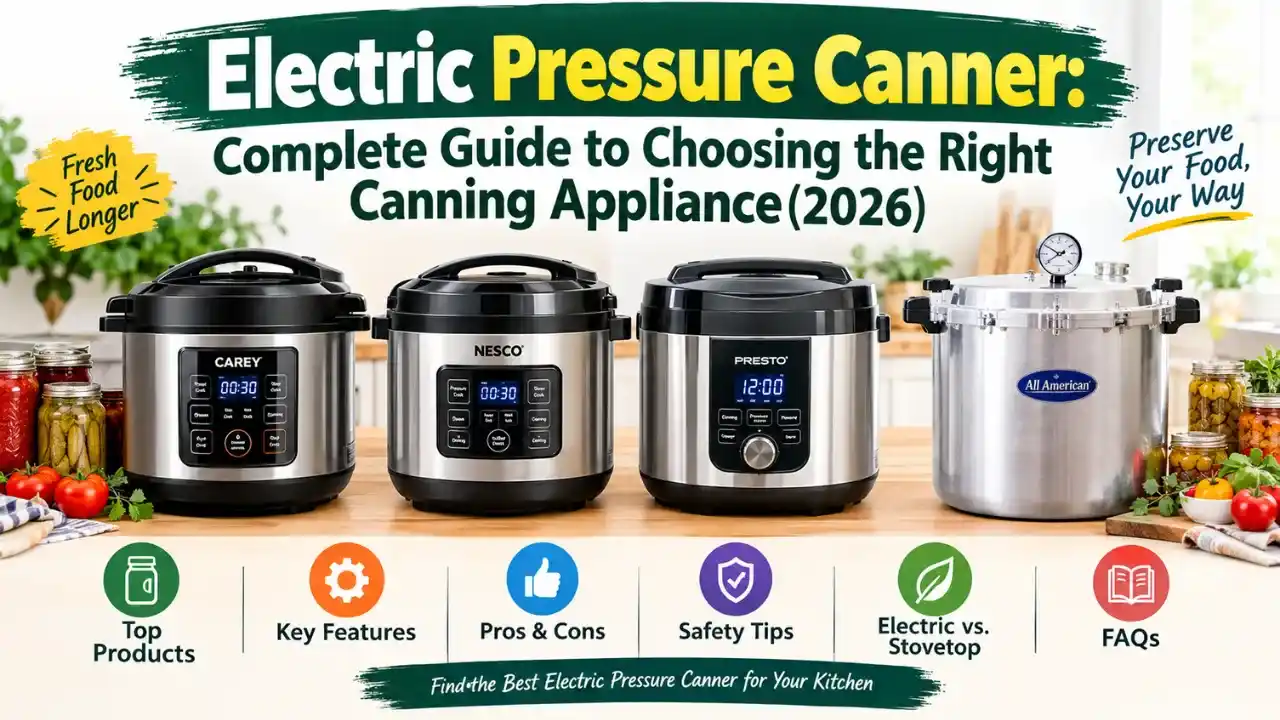
To make home food preservation a little easier, electric pressure canners automate certain steps in the pressure-canning process. If you have been thinking about canning vegetables, meats, sauces or other foods this is a helpful piece of information; if you want to use a pressure canner, make sure it is designed for that purpose and follow tested recipes and processing directions.
Since your niche is on food dehydrators, it would also be good to know what pressure canning is related to and how it differs from dehydration. Harvested food becomes dehydrated by being released of moisture (drier), while pressure canning is a method for the control and preservation of liquids in sealed jars using controlled heat and pressure.
Comparison table
| Product | Capacity | Main Feature | Best For |
|---|---|---|---|
| CAREY DPC-9SS Smart Electric Pressure Cooker and Canner | 9.5 qt | Dedicated canning function | Multi-purpose home use |
| NESCO NPC-9 Smart Electric Pressure Canner | 9.5 qt | Digital presets | Canning and everyday cooking |
| Presto 02152 17-Quart Digital Pressure Canner | 17 qt | Automatic temperature control | Larger batches |
| All American 1930 10.5qt Pressure Cooker/Canner | 10.5 qt | Metal-to-metal seal | Traditional pressure canning |
Also read: Best Propane Burners for Outdoor Cooking
1. CAREY DPC-9SS Smart Electric Pressure Canner
The CAREY DPC-9SS is a pressure canner cooker for the multi-purpose electric pressure cooker that combines both pressure cooking and everyday use. Its dedicated canning function, along with digital controls, makes it a one-stop-shop for users who want multiple appliances in a single small footprint.
Key Features
• 9.5-quart removable nonstick inner pot
• Dedicated pressure-canning function
• Digital LED display and pre-set programs
• Automatic safety lock lid and float, valve
• Pressure cook, Slow cook, Steam and water-bath
• Includes canning and steam racks
Pros
• Multi-purpose design
• Digital controls
• Automatic safety features
• Spend friendly for each day cooking and preservation
Cons
• Less capacity than some conventional canners
• More bits to clean than a simple pot

Also read: Dehydrating Fish in a Dehydrator
2. NESCO NPC-9 Smart Electric Pressure Canner
Another electric pressure canner is a NESCO NPC-9 with 9.5 quarts, multiple cooking functions and also digital controls. It would serve well for those home preservers who also want an appliance for soups, stews, steaming and other meals.
Key Features
• 9.5-quart removable nonstick pot
• Digital display with pre-programmed programs and a timer
• Automatic float valve and pressure regulation
• Safety-lock lid
• Include pressure cooking, slow cooking, steaming & water-bath
• Included are the two canning rack and steam rack
• Removable condensation catcher
Pros
• Convenient digital operation
• Multiple cooking modes
• Built-in safety features
• Useful for batch cooking
Cons
• Lower capacity than large conventional canners
• Not the same design as an ordinary stovetop pressure canner.

3. Presto 02152 17-Quart Digital Pressure Canner
The larger of the two electric pressure canners in this review, the Presto 02152, is designed for most automated canning control creations. The 17-quart size can help those who want to process larger batches than a 9.5-quart appliance.
Key Features
• 17-quart capacity
• Digital LED display
• Automatic temperature-sensing system
• Canning method and processing time control knob
• Specifically for pressure and boiling-water canning per product instructions
• Extra-tall design for larger jars
Pros
• Larger capacity
• Automated controls
• Digital display
• Designed for batch processing
Cons
• Takes more storage space
• Much more massive and larger than small electric models

4. ALL AMERICAN 1930 10.5qt PRESSURE COOKER CANNER
The All American 1930 10.5 quart model is not like the electric models above. Instead of an electric heating element, it uses a stovetop to boil water in its big pot and build steam pressure within the unit.
For shoppers researching an All American pressure canner, it is a style that might attract those who like classic appliances and a strong build.
Key Features
• 10.5-quart capacity
• Metal-to-metal sealing system
• No conventional replaceable gasket
• Easy-to-read pressure gauge
• Precision-machined regulator weight
• Durable cast-aluminum construction
Pros
• Traditional pressure-canning design
• Durable construction
• Metal-to-metal sealing system
• Since it’s very useful with pressure cooking and canning
Cons
• Not an electric appliance
• Requires a compatible stovetop
• Manual operation requires closer monitoring

Electric Pressure Canner: What to Know Before Choosing One
Electric pressure canners simplify the home food preservation process by providing controlled heating, pressure management, and even some digital functionality. With regard to a food-preservation kitchen, it can expand on a food dehydrator, since canning and dehydration preserve foods in different ways.
Factors to consider when picking a model include capacity, temperature and pressure controls, safety features required for home canning, jar capacity, cleaning ease and if the appliance is designed for pressure canning. The products below are made with different methods—from electric multi-function models to stovetop equipment.
How an Electric Pressure Canner Fits a Food-Preservation Kitchen
Electric Pressure Canner: While at home kitchens that are focused on the food dehydrator, consider using an electric pressure canner.
For example:
• Dehydrator: dehydrates apples, bananas, herbs, vegetables, mushrooms and jerky.
• Pressure canner: used to jar suitable low-acid foods.
• Water-bath canner: processes recipes approved for high-acid canning.
• Pressure cooker: prepares meals quickly.
• Storage containers: moisture-proof storage of dehydrated foods after drying.
These two together provide home food preservers with various methods in how they can deal with different foods.
Final Thoughts
If you have a low moisture and low-acid food (you would not be using a CSA or hot water bath for), an electric pressure canner may work well in concert with your home food-preservation setup – especially if you’re looking for lots of automated controls with multiple cooking functions. The CAREY DPC-9SS and NESCO NPC-9 provide small multi-purpose designs, while the Presto 02152 features a larger digital display. You could also opt for a classic stovetop with the All American 1930.
For a food dehydrator niche, the main difference is pretty cut and dry: dehydrators remove moisture versus preservation of sealed jars in controlled heat/pressure (pressure canners). The best appliance for you depends on what foods you preserve, how big your batches are or the type of preservation method you’re going to use, and the size of your kitchen.
FAQs
Q1. What is an electric pressure canner?
An electric pressure canner is an electrically powered appliance designed to process foods under controlled pressure and temperature. Models vary, so always follow the instructions supplied for the specific appliance.
Q2. Can an electric pressure canner replace a food dehydrator?
No. A dehydrator removes moisture from food, while an electric pressure canner processes food in jars. They perform different preservation functions.
Q3. Is an All American pressure canner electric?
No. The All American 1930 is a traditional stovetop pressure cooker/canner rather than an electric appliance.
Q4. What is the difference between a pressure pot and a pressure canner?
A pressure pot or pressure cooker is primarily designed for cooking. A pressure canner must be specifically appropriate for pressure-canning processes. Not every pressure cooker is suitable for canning.
Q5. Can I use an electric pressure cooker for canning?
Do not assume that a standard electric pressure cooker is suitable for pressure canning. The National Center for Home Food Preservation does not recommend using its USDA pressure-canning processes in ordinary electric multi-cookers because validated thermal processing may not exist for those appliances.
Q6. Which foods are commonly pressure canned?
Tested pressure-canning procedures include certain low-acid foods such as meats and vegetables. Always use a tested recipe for the specific food rather than creating your own processing time.
Q7. Is an All American pressure cooker for canning the same as an electric model?
No. An All American pressure cooker for canning uses stovetop heat, while an electric model has an integrated electrical heating system and electronic controls.
Q8. Can I use a dehydrator and pressure canner together?
Yes. They complement each other because they use different preservation methods. A dehydrator is useful for moisture removal, while an appropriately designed electric pressure canner can be used for tested pressure-canning procedures.