

A good food dehydrator can help you prepare healthy snacks, jerky, dried fruits and vegetables, and herbs at home. Given the variances in tray capacities, temperature settings, timers and airflow systems available – you have to understand based on your cooking and batch size as to which model suits best. We have compiled a list of five of the best food dehydrators below to help you choose the right one for your kitchen.
Quick Comparison
| Product | Best For | Trays | Temperature Range | Timer |
|---|---|---|---|---|
| Cosori Food Dehydrator | Large batches | 6 stainless steel | 95°F–165°F | Up to 48 hours |
| Excalibur Food Dehydrator | Large drying capacity | 8 chrome | 85°F–165°F | Up to 80 hours |
| NESCO FD-75A Snackmaster Pro | Expandable drying | 5–12 | 95°F–160°F | — |
| PSIIDAN Food Dehydrator | Family-size portions | 8 stainless steel | Up to 167°F | 30 minutes–48 hours |
| Elite Gourmet Food Dehydrator | Home use | Multiple removable trays | 95°F–158°F | Up to 24 hours |
Also read: Backpacking Food Recipes
1. Cosori Food Dehydrator
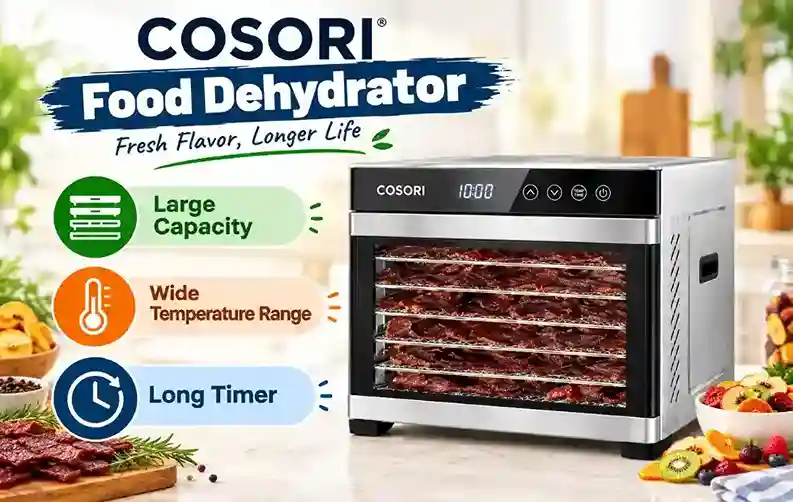
The Cosori Food Dehydrator makes the sweetest snacks from fruits, vegetables, herbs and jerky — perfect if you’re making a big batch. It has stainless steel trays, a quieter motor and accurate digital controls for regular household use.
Features:
• 6 stainless steel trays
• 6.5 ft² drying space
• 600-watt motor
• Temperature range of 95°F–165°F
• Timer up to 48 hours
• Brushless motor operation with less than 48 dB noise
• Dishwasher-safe trays
• The kit has mesh screen and fruit roll sheet
Pros:
• Large drying capacity
• Quiet operation
• Precise temperature control
• Long 48-hour timer
• Easy-to-clean trays
Cons:
• Six trays not ideal for very large batches
• Larger footprint than basic dehydrators
Also read: Drying Fruit Without a Dehydrator
2. Excalibur Food Dehydrator
Great for anyone wanting maximum drying space and extended drying times, the Excalibur Food Dehydrator. Its horizontal airflow system circulates warm air for uniform heating without the need to rotate trays.
Features:
• 8 chrome trays
• Hyperwave Pulse Technology
• Horizontal Parallex Air Flow
• Temperature range of 85°F–165°F
• Timer up to 80 hours
• Clear glass French doors
• Compact design
Pros:
• Eight trays provide good capacity
• Wide temperature range
• Very long timer
• Even drying
• Convenient Access Through Glass Doors
Cons:
• Chrome trays are a little more demanding than stainless steel
• Larger volume may also translate into a larger footprint

3. NESCO FD-75A Snackmaster Pro Food Dehydrator
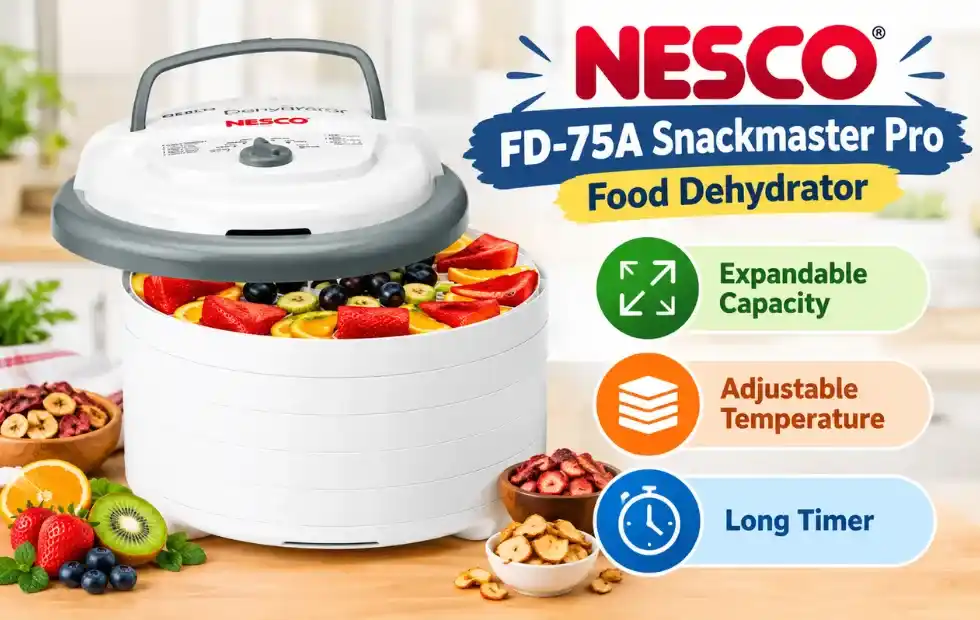
The NESCO FD-75A Snackmaster Pro is versatile for users starting at a smaller batch size and scaling from there. You can increase its tray capacity as your needs in terms of food-preservation change.
Features:
• 600-watt drying system
• Starts with 5 trays
• Expandable up to 12 trays
• Converga-Flow airflow
• Temperature range of 95°F–160°F
• Top-mounted fan
• Contains Fruit roll sheets and Clean-A-Screens
Pros:
• Expandable capacity
• Good airflow system
• For jerky and dried fruits
• Useful accessories included
• Manufactured both domestically and overseas.
Cons:
• Smaller base capacity than many 8-tray models
• Extra trays not included in purchase
4. PSIIDAN Food Dehydrator
If you’re looking for something you can make bigger batches with, the PSIIDAN Food Dehydrator features eight stainless steel trays. Features a wide range of temperature and long timer, ideal for fruits, vegetables, herbs, jerky and pet treats.
Features:
• 8 stainless steel trays
• Temperature up to 167°F
• Timer → 30 min to 48 hours
• Dual-layer insulation
• Overheat protection
• Interior light
• Automatic fan cooling
• Comes with wire mesh, drip tray and recipe book
Pros:
• Large 8-tray capacity
• Long 48-hour timer
• High maximum temperature
• Useful safety features
• Suitable for overnight operation
Cons:
• Eight trays might take up quite a bit of cabinet space
• Could be excessive for non-frequent users

5. Elite Gourmet Food Dehydrator
Elite Gourmet Food Dehydrator An easy, everyday dehydrator for use at home You get temperature and timer options, and it works with airflow to circulate heat during the drying phase.
Features:
• Temperature range of 95°F–158°F
• Timer up to 24 hours
• Horizontal airflow
• Bottom-mounted fan
• Transparent trays
• Dishwasher-safe removable trays and lid
• 350-watt power
Pros:
• Simple to operate
• Good for beginners
• Transparent trays make monitoring easy
• Dishwasher-safe parts
• Great for fruit, herbs, snacks and pet treats
Cons:
• Some competitors boast longer 24-hour timers
• Not as powerful as 600 watts
• You might not be doing very large batches so it may be but.

Why Consider These Food Dehydrators?
The following food dehydrators offer a balance of capacity (both food and space wise), temperature/heat control, drying ability, convenience and versatility. There is a size for beginners and one for preparing large batches on a regular basis.
• Cosori Food Dehydrators: Great for big batches, quiet operation, and digital temperature control.
• Excalibur Food Dehydrator: Good for anyone who wants eight trays, even airflow and a long 80-hour timer.
• NESCO FD-75A Snackmaster Pro — a versatile option that can be expanded from 5 to 12 trays.
• PSIIDAN Food Dehydrator: Extreme capacity with eight stainless cheap steak trays, a 48-hour timer and plenty of safety features
• Elite Gourmet Food Dehydrator – A basic / entry-level style home dehydrator that is budget-friendly and easy to use, with trays that are dishwasher-safe as well as simple dials or knobs.
Combining these models will satisfy all of your needs from rarely manufacturing a few homemade treats to frequently preserving large quantities of food.
How to Choose the Best Food Dehydrator for Your Need
• Tray Size: If you can prepare dozens of pounds of fruits, vegetables, herbs and jerky at one time, opt for more trays.
• Temperature Range: A broader temperature range allows you to use it for a variety of foods.
• Pay Attention to Timer Settings A more significant timer is good as far as the foods that require a prolonged period of drying.
Dry food uniformly without having to rotate trays around frequently. • Airflow system check the airflow, then every thing should be uniform and balance.
• Power: Higher wattage, if the design permits will heat stronger and dry faster.
• Consider Noise: If you intend to use the dehydrator overnight, purchase a model that is quieter at work.
• Cleaning Features: Look for features like dishwasher-safe trays and detachable components to make cleaning a breeze.
• Check for Safety Features: Overheat protection and automatic shutoff can bring additional ease of use and peace of mind.
• Look At Accessories: Mesh Screens, Fruit Roll Sheets, Drip Trays And Recipe Books Are All Great Add-Ons.
• Match It to Your Needs: Pick a model according to how often you dehydrate it, make the kind of food that you will be processing dryed up for batch sizes!
Final Verdict
Ultimately, selecting the ideal food dehydrator for your requirement is determined by your batch size and choices in foods and features. The best all around choice when you need a higher capacity dryer but the Cosori Food Dehydrator combines a larger drying space, very quiet operation, and precise controls. The Excalibur Food Dehydrator is best for bigger batches and longer drying times, and the NESCO FD-75A Snackmaster Pro is great because you can expand it. The PSIIDAN Food Dehydrator is a basic, competitive choice for families looking for eight trays and with certain useful safety features, while the Elite Gourmet Food Dehydrator proves well-suited to simple homeal everyday use.
All in all, take into consideration your space, budget, capacity need and the foods you want to dehydrate before choosing which model to buy.
FAQs
1. What is the best food dehydrator?
Cosori is a strong all-around choice for capacity, quiet operation, and precise controls.
2. What can I make in a food dehydrator?
You can make jerky, dried fruits, vegetables, herbs, fruit leather, and pet treats.
3. How many trays should a dehydrator have?
Six to eight trays are suitable for most households and larger batches.
4. What temperature should I use?
The ideal temperature depends on the food, so always follow the recipe or manufacturer’s guidance.
5. How long does food take to dehydrate?
Drying time varies by food type, thickness, moisture content, and temperature.
6. Are food dehydrators easy to clean?
Yes. Models with dishwasher-safe removable trays are generally easier to clean.
7. Can I run a food dehydrator overnight?
Many models have long timers and quiet operation, but always follow the manufacturer’s safety instructions.

1 Comment
[…] Also read: Best Food Dehydrator for Your Need […]